
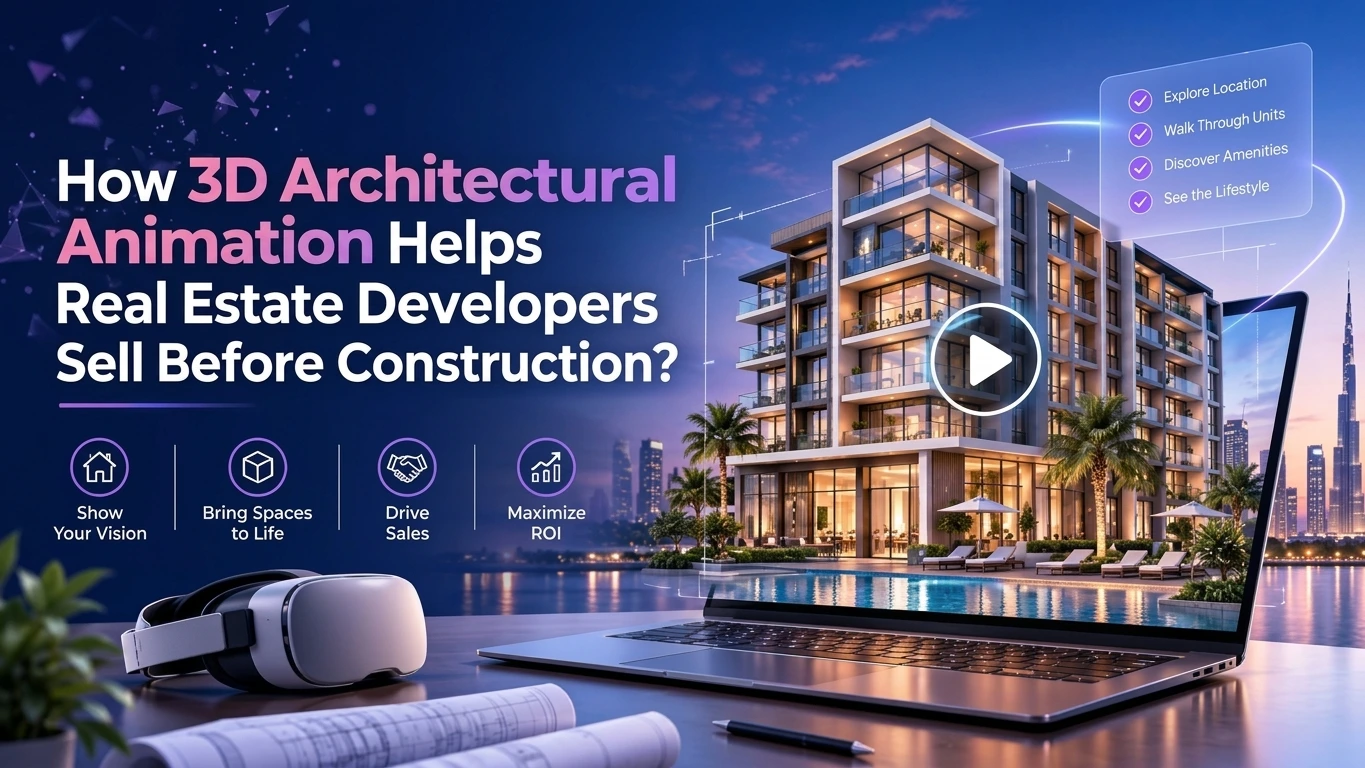
Your buyers can’t walk through a building that doesn’t exist yet. Give them the next best thing.
In November 2026, off-plan deals made up roughly 70% of Dubai’s residential sales, according to Betterhomes data. In markets like that, most buyers commit to a home they have only seen on a screen. 3D architectural animation is what that screen shows them: the arrival, the lobby, the light in the living room at 5 p.m., and the view from the balcony. This guide covers how developers use it across each sales phase, what a strong flythrough contains, and how to keep the promise on screen honest.
Off-Plan Buyers Are Buying a Picture
Selling a finished apartment is about showing what’s there. Selling off-plan means asking someone to commit a deposit, often 10 to 20% of the price, against a plot of sand, a hoarding, and a brochure. The buyer has to picture the home and also trust that the developer will deliver what they picture.
Floor plans don’t close that gap, which is the problem architectural visualization exists to solve. Most people can’t read them well, and almost nobody can read a section drawing. Still renders help, but each one is a single frame, chosen to flatter. Movement is what makes a space believable, and it is the main reason architectural visualization now leads most off-plan campaigns. When the camera walks from the front door to the kitchen to the terrace in one continuous shot, the buyer understands proportion, flow, and light in a way no plan set can deliver.
That is why architectural visualization has moved from the design office into the sales center. A 2022 Rocket Mortgage survey reported by the National Association of Realtors found that 60% of home shoppers would be willing to buy after only a virtual tour. Off-plan buyers have no physical tour as an option, which makes the virtual one the whole show.
Introduce Your Script
To The World With Our
Explainer Videos

One Model, Five Sales Phases
A development sells in phases, and the buyer’s question changes at each one. The same 3D model can answer all of them if it is planned that way from the start.
| Phase | Who is watching | Their main question | Asset that answers it |
| Land and approvals | Investors, lenders, planning authorities | “Is this viable, and does it fit the site?” | Massing and context animation, sun studies |
| Launch and VIP preview | Brokers, early buyers | “Why this project, and why now?” | Hero launch film, 60 to 120 seconds |
| Off-plan sales | End users, investors | “Which unit, and what will it feel like?” | Unit walkthroughs, view simulations, amenity films |
| Construction | Existing buyers, late-stage prospects | “Is it on track?” | Progress overlays blending site footage with the model |
| Handover and resale | Owners, agents | “How do I show it off?” | Lifestyle cutdowns for listings and social |
Most developers commission the launch film and stop. The model then goes unused, even though the most persuasive work, unit-level walkthroughs that help a buyer choose between a 12th-floor and a 30th-floor apartment, could come from the same source files for a fraction of the first cost. Planning 3D architectural animation as a campaign asset from day one changes the economics of the whole project.
Anatomy of a Flythrough That Sells
A good flythrough follows the order a visitor would experience the building. Each sequence has one job, and a common failure is a film that spends ninety seconds circling the tower and never goes inside.
The Establishing Shot: Location First
Open on the neighborhood before the building. Show the waterfront, the metro station, the school, and the highway interchange, with travel times on screen. Buyers pay for location first, and the opening shot should prove the location is worth it before it asks them to care about the façade.
The Arrival Sequence
Follow the route a resident would take: the entrance gate, the drop-off, the landscaped approach, the lobby doors opening. Arrival sets expectations for quality. A double-height lobby with real stone textures and soft evening light does more for perceived value than any amenity list.
Amenities in Use
An empty pool reads as a rendering. A pool with residents, towels on loungers, and late-afternoon shadows reads as a lifestyle. Populate amenity scenes with people, and match them to the target buyer: families for a suburban community, young professionals for a city-center tower.
The Unit Interior
This is where the sale is usually made. Walk through the actual layout at eye level, at a walking pace, with furniture placed to show scale. Hold on the kitchen island and the main bedroom. Let the camera stop at the window so the buyer can see the view.
The View and the Light
Real sun-path data can show exactly how light falls into a west-facing living room at sunset, or which floor first clears the neighboring building. 3D property visualization at this level answers the question every investor asks: is the premium for a higher floor worth paying?
From Architect Files to Finished Film
Developers already have most of what a studio needs. The architect’s model is the starting point, and the cleaner the handoff, the faster and more accurate the result.
What to send:
- The architectural model. Revit, ArchiCAD, SketchUp, and Rhino files all work. A BIM model is ideal because it carries real dimensions and material tags.
- Site and context data. Survey drawings, neighboring building heights, and drone or satellite imagery of the plot and surroundings.
- The finishes schedule. Material specs for flooring, cladding, glazing, joinery, and fittings, with supplier samples or product codes.
- The landscape plan. Planting species, hardscape materials, and water features.
- Brand and marketing guidelines. The project name, logo, color palette, and the buyer persona the sales team is targeting.
From there, the studio rebuilds the model for rendering, applies photorealistic materials, sets up lighting for time-of-day sequences, populates scenes, and animates the camera. The stages follow a standard 3D animation pipeline and process, with an extra review loop where the architect confirms that proportions and details match the approved design.
Architectural rendering and animation are best commissioned together. The same scene setup that produces the hero stills for the brochure and billboards produces the film, so one budget covers both and the visual language stays consistent across every channel.
Where Property Animation Videos Do the Selling?
The film is only useful where buyers see it. Plan distribution with the same care as the shot list, because real estate marketing videos only sell in the places buyers already look.
- Sales gallery screens. A large-format loop runs behind the physical model and keeps working on walk-ins between appointments.
- Broker kits. Brokers in other cities and countries sell what they can show. Give them short property animation videos with and without voiceover, in several languages if the buyer pool is international.
- Project landing pages. The hero film above the fold, unit walkthroughs beside each floor plan, and the amenity film beside the facilities list.
- Paid social and portals. Vertical cutdowns of 15 to 30 seconds for Instagram, TikTok, and YouTube Shorts, plus listing videos for property portals.
- Roadshows and exhibitions. International property shows in London, Hong Kong, and Riyadh rely on video to sell projects thousands of miles away.
Each placement needs its own cut, and property animation videos that ignore this end up cropped badly by whichever platform they land on. A 2-minute launch film will not survive a social feed, and a 15-second vertical clip can’t carry a sales gallery. This guide to the best video lengths for animated ads by platform helps size each version, and our social media animation team handles the vertical cutdowns from the same renders.
Keep the Promise on Screen Honest
Off-plan marketing carries a legal and reputational risk that most other video work doesn’t. If the handed-over apartment looks noticeably worse than the film, buyers notice, and some of them call lawyers.
- Match the approved design. Animate the plans that were approved, and update the film when the design changes.
- Show the real finishes. If the standard unit ships with laminate, don’t animate oak. Label upgrade options clearly.
- Keep the context truthful. Show the neighboring tower that will block part of the view. Leaving it out invites complaints later.
- Add on-screen disclaimers. A short line such as “Artist’s impression. Final finishes may vary” protects the developer and sets fair expectations.
- Follow local advertising rules. Many markets regulate property ads. Dubai, for example, requires an advertising permit for real estate marketing, so build approval time into the schedule.
Honest 3D real estate animation sells just as well as the exaggerated kind, and it leaves you with buyers who refer friends instead of filing complaints.
Three Objections Developers Raise, and Straight Answers
Every developer weighing a film budget hears some version of these three objections from the board or the sales director.
“Renders Are Enough”
Renders are essential, and they are also static. A buyer looking at four beautiful stills still can’t tell how the kitchen connects to the living room, or how far the bedroom is from the front door. Motion answers flow and proportion. Use renders for print and listings, and use 3D architectural animation where buyers make the decision.
“Buyers Don’t Trust CGI”
They distrust bad CGI: plastic-looking surfaces, empty rooms with perfect symmetry, and skies that don’t match the lighting. Photoreal materials, real sun data, people in the scenes, and small signs of life such as a coffee cup or a breeze in the trees close the gap. Choosing the right photorealistic or stylized 3D animation style also matters. A masterplan film for a 400-hectare community can be stylized; a luxury penthouse walkthrough has to be photoreal.
“It’s Too Expensive for a Mid-Size Project”
Measure it against the alternative. A show apartment can cost far more than a film once you add construction, furnishing, staffing, and the rent on the space, and it shows only one unit type in one city. A film works in every broker’s inbox at the same time. Breaking the cost down by scope, length, and realism, as in our 3D animation cost guide, usually shows that a well-planned film is one of the cheaper line items in the marketing budget.
How Do Developers Measure the Return?
Track the numbers your sales team already reports, and compare launches with and without animation. The film earns its budget when it moves the metrics that decide cash flow.
| Metric | What it tells you |
| Reservations in the launch window | How many buyers committed before the first price increase |
| Enquiry-to-appointment rate | How well the film turns casual interest into sales-gallery visits |
| Broker lead volume by market | Which overseas markets respond to the broker kit |
| Achieved price per square foot | How the project prices against comparable launches nearby |
| Video completion and replay rate | Which scenes buyers rewatch, usually the unit interior and the view |
Read the replay data closely. If buyers keep rewatching the balcony view on the higher floors, that is evidence for a floor premium. If they skip the amenity sequence, shorten it in the next cutdown. Real estate marketing videos are cheap to re-edit once the renders exist, so treat the first month after launch as a test and adjust the cuts based on what buyers watch.
Good 3D property visualization also shortens the conversation in the sales gallery. Buyers arrive having already chosen a unit type, so agents spend their time on payment plans and availability instead of explaining the layout from scratch. For a large phase with hundreds of units, that time saving adds up to a real reduction in cost per sale, and it is one of the most underrated returns on 3D architectural animation.
The Developer’s Pre-Production Checklist
Work through these steps before you brief a studio or an architecture animation service. They apply to a single tower and to a multi-phase masterplan alike, and they make 3D real estate animation projects run on schedule.
- Fix the sales calendar. Launch date, broker preview, exhibitions, and the date the first cutdowns are needed.
- Confirm the design freeze. Animate approved plans only, and agree on a process for design changes.
- Define the buyer. End user or investor, local or international, family or professional. This shapes casting, lifestyle scenes, and language versions.
- Pick the unit types to animate. Usually the best-selling layout, the premium layout, and the hardest-to-sell layout.
- Collect the inputs. Model, site data, finishes schedule, landscape plan, and brand guidelines.
- List every deliverable. Hero film, unit walkthroughs, amenity film, stills, vertical cutdowns, and language versions.
- Plan regulatory approvals. Build permit or compliance review time into the release schedule.
- Agree on review gates. Storyboard, grey-box animatic, lighting pass, and final render, with the architect signing off on accuracy.
What to Look For in a Studio?
Strong real estate marketing videos sit between architecture and advertising, so the right studio needs both skills. Look for a portfolio with completed projects similar to yours in scale and price point, interior work that holds up at eye level, and evidence of strong editing and music choices as well as technical renders. Ask how they handle design changes mid-production, and confirm that you will own the 3D model at the end, since it will keep earning through construction and handover.
A dedicated architecture animation service will also ask about your sales calendar before it asks about camera angles. That’s the sign of a partner who understands the job. Our guide on how to choose a 3D animation company covers the vetting questions in more detail.
Start Selling the Building Before It Stands
Your buyers are making a large decision about a home they can’t visit. Pixel Studios Inc. builds 3D architectural animation that lets them walk through it anyway, from the neighborhood establishing shot to the view from their balcony, using your architect’s model and approved finishes. See how we approach property projects on our real estate animation and architecture animation services pages.
For launch films, masterplan flyovers, and interiors produced under one roof, explore our wider 3D animation services.
When your launch date is set, book a free project consultation. Bring your sales calendar and your plans, and we’ll show you how one model can carry your campaign from launch to handover.
Introduce Your Script
To The World With Our
Explainer Videos
Frequently Asked Question?
What is 3D architectural animation?
3D architectural animation is a computer-generated video that shows a building or development before or during construction. It uses the architect’s design model, adds realistic materials, lighting, landscaping, and people, and moves a virtual camera through the exterior, amenities, and interiors so buyers and stakeholders can experience the space.
How long does it take to produce a real estate animation?
A 60 to 120 second launch film usually takes six to ten weeks, depending on the size of the development, the number of interior scenes, and how quickly design details are confirmed. Unit walkthroughs and cutdowns built from the same model can follow in two to four weeks.
What files do architects need to provide for 3D property visualization?
Studios work best with the native or exported architectural model (Revit, ArchiCAD, SketchUp, or Rhino), site and survey data, a finishes schedule, and the landscape plan. Brand guidelines and buyer personas help the studio match lifestyle scenes and tone to the target market.
What is the difference between architectural rendering and animation?
Architectural rendering produces still images, usually for brochures, billboards, and listings. Animation adds camera movement and time, showing how spaces connect, how light changes through the day, and what arriving at the building feels like. Most developers commission architectural rendering and animation together from the same model.
Can 3D real estate animation be updated if the design changes?
Yes. Because the film is built from a 3D model, studios can update materials, layouts, or landscaping and re-render the affected scenes. Changes are cheapest before final rendering, so agreeing on a design freeze date early keeps revision costs down.

