
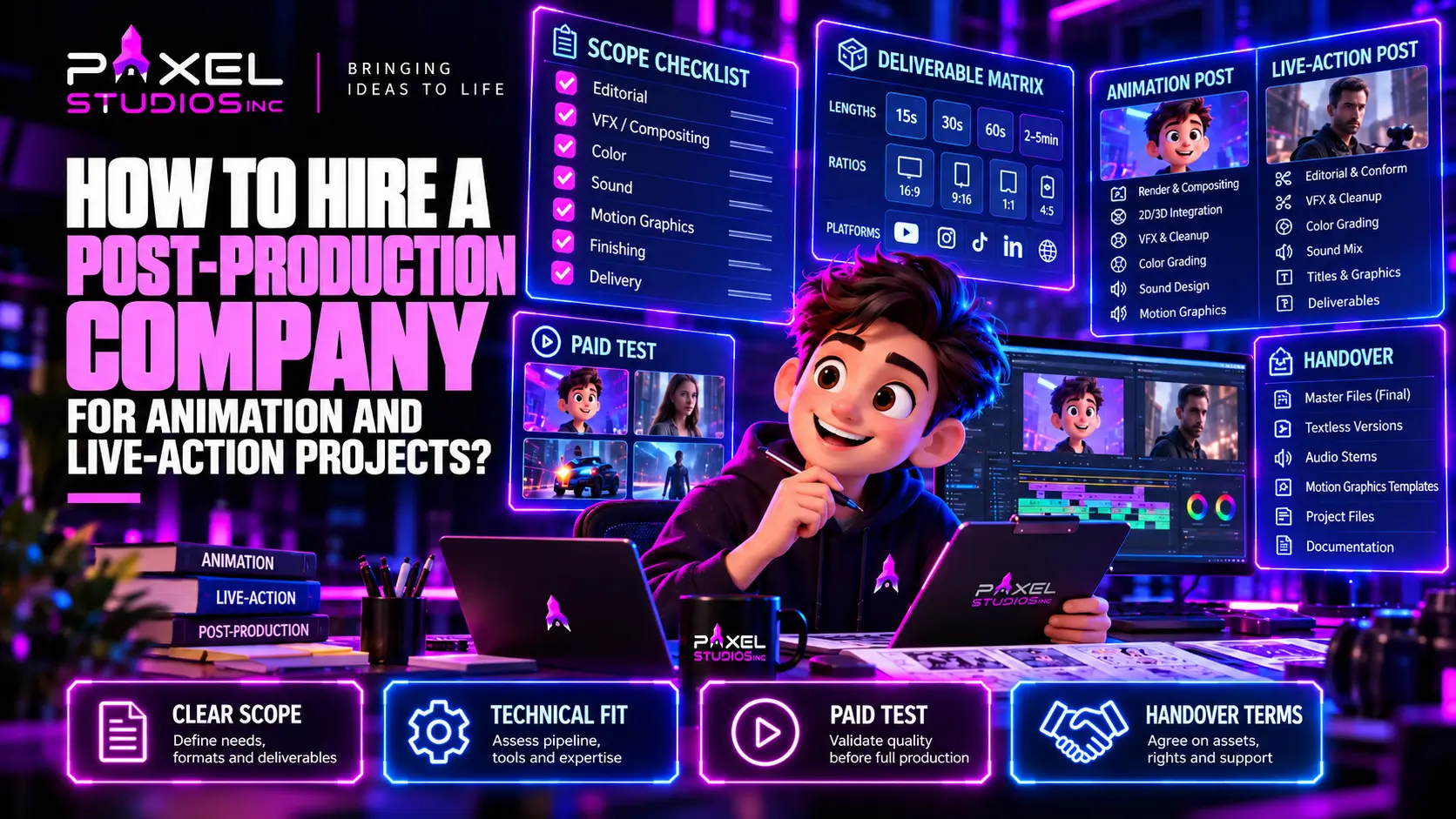
Most post-production relationships go wrong for reasons that were visible during vetting, and nobody asked about: an undefined scope, an unstated colour space, a revision allowance that was never counted, a handover that turned out to be a flattened file. Hiring a post-production company well is mostly a matter of asking technical questions early rather than creative ones late. This guide covers the questions that predict how an engagement will actually run.
Define the Scope Before Approaching Anyone
Every useful conversation with a post-production company starts from a written scope rather than a description of the project.
Post-production is six or seven disciplines, and a brief that says “we need an editor” invites a quote against assumptions a buyer never stated. Writing the discipline list first is the single highest-leverage preparation step available.
The Discipline Checklist
Work through each line and mark it in scope, out of scope, or undecided:
- Ingest and media management: transfer, logging, backup, proxy creation
- Editorial: assembly through picture lock, including the number of expected review rounds
- Conform and online: relinking proxies to camera negatives at full resolution
- Visual effects and video compositing: clean-up, screen replacement, set extension, computer-generated elements
- Color: correction as a baseline, grading where a look is required
- Sound: dialogue clean-up, atmospheres, effects, music conforming, final mix
- Motion graphics editing: titles, lower thirds, callouts, data visuals, end cards
- Finishing and quality control: full-resolution conform, fix list, systematic checks
- Delivery: masters, textless version, platform versions, captions, audio stems
A buyer who hands this list to three vendors receives three comparable quotes. A buyer who describes the project in prose receives three quotes priced against three different readings of it. The full technical sequence behind each line sits in the guide to video post production.
State the Deliverable Matrix Numerically
The second half of scope definition is counting outputs. Lengths, aspect ratios, platforms, languages. A campaign delivering four lengths across two ratios on four platforms is twenty-four files, each needing graphics rebuilt and a colour trim for its viewing conditions. Vendors quote this very differently, and a numeric matrix is the only way to compare. The economics of that matrix are covered in the guide to video repurposing services.
Introduce Your Script
To The World With Our
Explainer Videos

Animation Post and Live-Action Post Need Different Things
The pipelines overlap substantially and diverge in ways that matter when choosing a vendor.
| Live-action post | Animation post | |
| Source material | Camera negatives, production sound | Rendered sequences, no production audio |
| Early dependency | Ingest, proxies, conform | Render management, version control |
| Hardest scheduling risk | Reshoots, plate problems | Re-render time after a late change |
| Colour role | Correction is mandatory, grading optional | Unifies sequences rendered at different times |
| Sound load | Clean-up and enhancement of captured audio | Everything designed from nothing |
| Graphics load | Moderate to heavy | Often integral to the animation itself |
| Flexibility late in the process | Limited without a reshoot | Higher, at the cost of render time |
A vendor strong in one is not automatically competent in the other. A live-action house with deep conform and grading experience may have thin render-management discipline. An animation studio may have no experience conforming multi-camera footage or handling camera metadata from an unfamiliar body.
Projects combining both, which most commercial work now does, need a vendor comfortable on both sides or a clearly named handover point between the two. The format decision that precedes this, and its cost implications, is set out in the comparison of animation vs live action commercial production.
The Four Kinds of Vendor
| Type | Typical fit | Main risk |
| Freelancer | Single discipline, defined scope | Availability, single-point dependency |
| Boutique studio | Short-form commercial work, two or three disciplines | Capacity under a compressed deadline |
| Full-service post house | Multi-discipline work needing integration | Premium over freelance rates |
| Specialist VFX studio | Shot-heavy effects work | Needs editorial and color sourced elsewhere |
A video editing agency sits between the boutique and the full-service tiers, usually strong on editorial, graphics, and versioning, and often subcontracting heavier effects. That arrangement is fine when disclosed. It becomes a problem when a buyer discovers mid-project that the compositing is happening at a third party nobody mentioned.
The practical question is which disciplines a vendor holds internally. Ask it directly, discipline by discipline, against the checklist above. A video editing agency that is honest about subcontracting its effects work is a safer partner than one that implies full in-house capability it does not have.
What to Look for in a Reel, and What to Ignore?
A reel is how most buyers first judge a post-production company, and it is the weakest evidence available.
A reel is a marketing asset built from best-case work, which makes it weak evidence on its own. Three requests turn it into useful information.
Ask for shot breakdowns rather than finished shots. Before-and-after comparisons on compositing work show the actual contribution. A finished shot shows the result of a whole pipeline, possibly including vendors who are not in the room.
Ask which shots the team completed in-house. Reels routinely include work a studio contributed to rather than delivered. This is a normal industry practice and worth clarifying.
Ask to see unglamorous work. Clean-up, screen replacement, and shot matching have nowhere to hide. A studio that can show invisible work is showing craft. A studio that only shows hero shots is showing ambition.
Motion graphics editing deserves its own request in this process. For graphics specifically, ask for work across three different brand systems rather than three pieces in one house style. Range matters more than polish, since the vendor will be working inside a brand’s visual language rather than their own. The element types to look for are set out in the guide to motion graphics video editing.
The Pipeline Questions That Reveal Real Capability
These are the questions that separate a technically competent post-production company from one that will produce surprises in the final week.
Color Space and Technical Alignment
Ask what color space the vendor works in and delivers in, and confirm it matches every other party on the project. Misalignment between a compositing vendor and a finishing house is among the most common causes of a delivery that looks wrong, and nobody can immediately explain.
Alignment extends to software versions, file formats, and rendering pipelines, and it belongs in onboarding rather than in the first delivery. A vendor that raises these questions before being asked is demonstrating exactly the discipline the engagement needs.
Conform Process
For live-action work, ask how the vendor conforms and what happens when camera media arrives from an unfamiliar body with incomplete metadata. Conform problems surface late and trace back to ingest decisions made weeks earlier. A studio with a documented process has seen this before. One that improvises has not.
Picture Lock Discipline
Ask what happens to the schedule and the budget when editorial changes arrive after picture lock. The answer reveals how the vendor runs its pipeline. A change after lock can invalidate color, sound, graphics, and effects simultaneously, and a vendor that treats this casually either has very few dependencies or has not thought it through.
Review Workflow
Ask which tools the vendor uses for review and what its typical response time is. Industry practice uses frame-accurate annotation platforms, because a note like “fix the edge near his shoulder” is useless without the exact frame attached. Shared cloud review with timestamped notes is a baseline expectation rather than a differentiator.
Ask also for the review cadence. Milestone reviews from kickoff, weekly or fortnightly, catch divergence early. Waiting for a final delivery to give the first substantive note is how projects end up rebuilt.
Security
For unreleased product work, confirm non-disclosure terms, secure file transfer, watermarked review material, and restricted access to production assets. This is routine for anyone working with pre-launch campaigns and worth confirming explicitly rather than assuming.
How Pricing Should Be Structured?
Post-production services get quoted four ways, and each suits a different kind of scope.
| Model | Suits | Watch for |
| Per shot | Clearly defined effects work | Needs a shot list with difficulty noted |
| Day rate | Evolving or exploratory scope | Open-ended total |
| Milestone | Defined deliverable list | Milestone definitions that are vague |
| Retainer | Continuous output, reserved capacity | A volume floor stated numerically |
Post-production services quoted as a single figure cannot be evaluated. A credible quote separates every discipline from the checklist above, states the shooting ratio assumed in the editorial figure, counts the revision rounds at each stage, and prices each delivery version individually. Effects work should arrive as a shot list rather than a single number, because thirty seconds could hold one easy shot or fifteen hard ones. The reasoning behind that, and current per-shot ranges, sits in the guide to video editing cost.
Treat an unusually low quote as a question rather than a win. It sometimes reflects genuine process efficiency. More often it reflects a thinner revision allowance, junior talent, undisclosed subcontracting, or a scope read more narrowly than the buyer intended.
Budget Contingency
Experienced producers carry roughly 10 to 20% contingency on the effects portion of a post budget. Shots reveal their difficulty once work starts, and a plate that looked straightforward can turn out to need rotoscoping that nobody scoped. A vendor that proposes a contingency line is being realistic rather than padding, and a post-production company that omits it on a shot-heavy brief is quoting optimistically.
Define a Revision Against a Scope Change
This single contractual definition prevents most billing disputes. A note asking for a different edge treatment on an existing composite is a revision. A note asking for an additional element in the shot is a scope change. Writing that distinction down, with examples, protects both parties.
The Handover Clause That Decides Long-Term Cost
What a client receives at the end determines what every future change costs, and it is the clause most often left unspecified.
A complete handover includes:
- A full-resolution master in the agreed color space
- A textless version, for later localization
- Split audio stems: dialogue, music, effects
- Every required platform version, with captions
- The grade held as project data rather than only baked into the master
- Graphics project files plus a documented template set
- Effects project files and element render passes
- Confirmation of intellectual property ownership covering final shots and intermediate assets
A client holding that set can re-cut, re-version, or change vendors without starting over. A client holding a flattened master cannot, and discovers it a year later when a product name changes. Specifying the handover before signing costs nothing. Negotiating it afterwards costs leverage.
It is also worth settling explicitly if the vendor may use the work in its own portfolio, which most studios want and some clients cannot permit.
Timeline, Capacity, and What Happens When You Slip
Two timeline questions matter more than the headline estimate.
What is the realistic schedule, rather than the best case? Ask for a timeline with named milestones and the assumptions behind each. A vendor quoting four weeks on the assumption of two-day approval turnarounds is quoting a schedule the client controls half of.
What happens when the client slips? Most post overruns trace to approval cycles rather than production. A storyboard or a cut sitting unapproved for nine days pushes delivery by nine days. Naming a single internal approver with authority, and booking their review time in advance, protects a timeline better than any contractual clause.
On capacity, a retainer reserves it, and a project engagement does not. A studio juggling three projects will priorities the client with a standing arrangement when a conflict arrives. For anyone with continuous output, that reservation is often worth more than the rate difference.
Time zone overlap deserves a direct question. A vendor with little working-hour overlap can produce excellent work, and every feedback round takes a day rather than an hour, which compounds across a project with several review cycles and a fixed launch date. Agreeing overlap hours for live discussion, and structuring work so a pending question does not block everything else, removes most of that friction.
Run a Paid Test First
For any engagement beyond a modest scope, a small paid test answers questions no reference call can. A sensible test on effects work is a shot package of three to five shots at varying difficulty. On editorial and graphics work, one short deliverable with a full review cycle.
What the test reveals:
- Technical compatibility: colour space, formats, resolution, render passes
- Turnaround under a real deadline rather than a quoted estimate
- How the team responds to the first round of notes, with a genuinely improved second pass or surface tweaks resubmitted
- How usable the reporting and review workflow turn out to be
- Does the vendor proactively flag problems, or wait to be asked
A vendor resisting a paid test while insisting on a long minimum term is asking the client to carry all the fit risk. The same logic applies across creative vendor categories, as the guide to selecting an animated video ad agency sets out for performance work.
Checking References Properly
Testimonials are curated. A reference call is useful only if the questions are specific:
- Did the final invoice match the original quote, and what changed if not?
- How did they handle a missed deadline or a scope dispute?
- How many revision rounds did shots typically need?
- How quickly did they respond to questions?
- Did their work need correcting to match the creative direction?
- Would you engage them again, and have you?
The last question is the most informative. Repeat engagement is the strongest available signal, and a studio that cannot produce a repeat client after several years is telling a buyer something.
Contract Terms Specific to Post
Beyond standard commercial terms, post engagements need these named:
- Deliverable specifications: resolution, frame rate, formats, color space, alpha channels, render passes
- Revision allowance per stage, with the revision-versus-scope-change definition
- Milestone payment schedule: partial at kickoff, progress payments, balance on approval
- Approval authority: who signs off, and the escalation path for creative disputes
- Quality control responsibility: who runs technical checks against the receiving platform’s specification
- Intellectual property, covering final shots and intermediate assets
- Termination terms and governing jurisdiction, which matters on international engagements
- Handover list, written out rather than described
Red Flags Worth Acting On
A flat number with no discipline breakdown. It hides where the money goes and makes comparison impossible.
Effects quoted from runtime. Shot count and difficulty drive the cost. A vendor quoting VFX services from a duration has not read the brief, and VFX services priced without a difficulty note per shot will be revised upward once work starts.
Vagueness about colour space. A studio that cannot answer this immediately will produce an integration problem.
No revision count. Revisions will happen. Unpriced revisions become the vendor’s leverage.
Silence on handover. Every future change will start from a rebuild.
Only hero work in the reel. Ask for clean-up and shot matching.
Undisclosed subcontracting. Discovering a third party mid-project undermines every assumption about capacity and accountability.
Resistance to milestone reviews. A vendor wanting to disappear until final delivery is managing a risk the client will absorb.
Matching Vendor Type to Project Shape
A few patterns hold across commercial work.
A short-form social campaign with heavy versioning and light effects suits a boutique studio or a video editing agency with strong graphics and templating, where motion graphics editing against a reusable template set carries most of the output. Video editing services bought as a package covering master plus derivatives avoid the version-control problems that appear when two suppliers hold different cuts of the same material.
A brand film combining live-action with computer-generated product elements needs integrated capability. Editorial, video compositing, colour, and finishing sitting in one pipeline removes the handover points where most integration failures occur. Buying video editing services, colour, and compositing from three suppliers can work, and it needs a named owner for the integration review.
A shot-heavy effects sequence inside an otherwise simple edit often suits a specialist VFX studio working alongside a separate editorial vendor, with the handover spec agreed in writing. The boundary between effects work and graphics work, which determines who owns what, is mapped in the comparison of VFX vs motion graphics.
An animation-led project with no live plates needs render management discipline above all, and the colour conversation shifts from matching cameras to unifying sequences rendered at different times, as the comparison of colour grading vs colour correction explains.
Measuring the Relationship After It Starts
Vetting predicts; measurement confirms. Five metrics tell a producer how an engagement is actually running:
- Revision rounds per shot or per deliverable. Rising counts signal a brief or a communication problem rather than a craft one.
- Response time to questions. Slow responses are the leading indicator of a slipping schedule.
- Correction needed to match creative direction. High correction means the vendor is guessing rather than understanding.
- Budget variance against the original estimate. Small variance is normal; a pattern of overage is not.
- Technical quality control pass rate on first delivery. Repeated spec failures point to pipeline discipline.
Tracking these across one project gives a clear basis for extending or ending the relationship, and it gives the vendor something concrete to respond to.
Making the Decision
Hiring a post-production company well comes down to three confirmations rather than a gut read on a reel. Post-production services are bought on process evidence, not showreels. Confirm that the scope is written as a discipline list and a numeric deliverable matrix, so quotes are comparable. Confirm that the technical questions have real answers: colour space, conform process, review workflow, picture lock handling. Confirm that the handover list is specified in the contract rather than discussed at the end.
A vendor that answers all three directly, and proposes a paid test without being pushed, is previewing how the working relationship will run. One that deflects on any of them is previewing that too.
Pixel Studios Inc. runs editorial, colour, compositing, graphics, and finishing as one pipeline for both animation and live-action work, with scope written as a discipline list, effects quoted from a shot list, and the handover specified before work starts, supported by its video editing, motion graphics, and 3D animation services capability.
Introduce Your Script
To The World With Our
Explainer Videos
Frequently Asked Question?
What should be defined before approaching a post-production company?
A discipline list covering ingest, editorial, conform, effects, colour, sound, graphics, finishing, and delivery, plus a numeric deliverable matrix of lengths, ratios, platforms, and languages. Without both, three vendors will quote against three different readings of the brief.
Is a vendor strong in live-action post automatically good at animation post?
No. Live-action post centres on ingest, conform, and grading camera material, while animation post centres on render management and version control, with all sound designed from nothing. Projects combining both need a vendor comfortable on each side or a named handover between two.
Why should visual effects be quoted from a shot list rather than a runtime?
Because difficulty varies enormously between shots. A locked-off plate with clean separation is quick, while the same effect on a handheld shot with motion blur and reflections can cost many times more, so a duration tells a vendor almost nothing useful.
What should a handover include to avoid future rebuild costs?
A full-resolution master, a textless version, split audio stems, every platform version with captions, the grade held as project data, graphics project files with a documented template set, effects project files with render passes, and written confirmation of asset ownership.
Is a paid test worth running before a larger engagement?
For most engagements, yes. A small shot package or one short deliverable with a full review cycle reveals technical compatibility, turnaround under a real deadline, and how the team handles a first round of notes, none of which a reference call can confirm.

